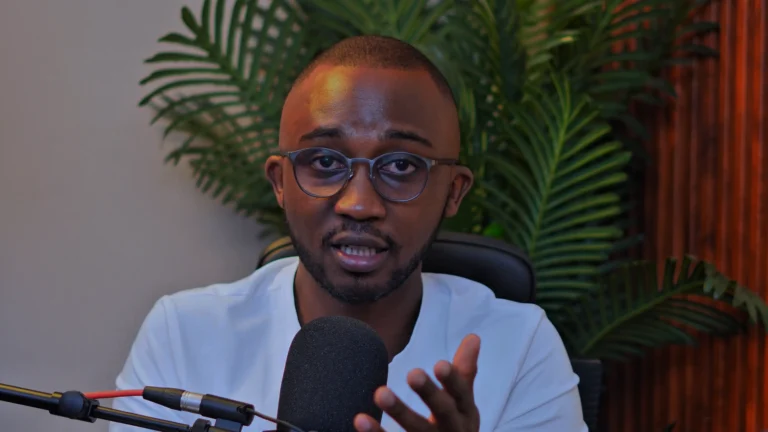
One of the best decisions I ever made was moving my work to Westlands.
Not living in Westlands. I want to be clear about that from the start, because people assume it. I operate from there. And from a coworking space in Westlands, not an office, which is a distinction that matters and I will get to it.
Let me tell you the whole story, because the decision looked wrong at the time and turned out to be the single most useful thing I did.
Watch the full video
Graduating into nothing
You already know the first part of this story because it is the same story as everybody else’s.
I graduated from Dedan Kimathi University with a degree in procurement. No job. Same as thousands of others that year.
What I did have was a business. I was running a cyber cafe in Nyeri, and alongside it I had built up real skill in graphic design. Posters. Company profiles. Branding work. By then I was genuinely good at it.
And the money was decent. I was doing 30,000 to 80,000 shillings a month, sometimes pushing to 100,000 or 150,000.
Now understand what that money meant in Nyeri.
Rent was 6,000 shillings. Internet 2,500. Water on top of that. So you can imagine what 100,000 felt like against that cost base. I had money. I could buy things. Life was comfortable.
Comfort was the problem
And that is exactly what worried me.
I was comfortable, and comfortable is where growth stops. Not immediately, and not dramatically. It just quietly ends, and you do not notice for 3 years.
The arithmetic was working beautifully in my favour, which meant I had no reason to change anything, which meant I would still be doing the same posters at the same prices for the same clients a decade later.
So I decided to challenge myself and move to Nairobi.
Here is something worth understanding about that kind of decision. Sometimes you are afraid of a thing because you have decided it is the wrong move, and it turns out to be the best decision you will ever make for yourself. You cannot tell the difference from where you are standing. You only find out by going.
The culture shock was immediate
The first thing Nairobi did was shock me.
You walk into a place and the prices are completely different from what you have built your entire sense of money around. A thing that would have been unthinkable in Nyeri is just ordinary here. Everything recalibrates at once.
That shock was uncomfortable and it was also the point. My sense of what things cost, what people earn and what is normal had been shaped entirely by one small environment. Nairobi broke that in about a week.
Why I chose the business district
Then I made a deliberate choice about where in Nairobi to operate, and I chose Westlands.
Not because it is pleasant. Because it is where business happens.
If you are trying to learn how money moves, you have to be where money is moving. You cannot study it from a distance and you certainly cannot study it from a town where nothing is happening.
But here is the part people get wrong when they hear this.
I did not open an office
Who decided you need an office in Westlands?
I did not open one. I do not have one. I took a membership at a coworking space, Skyrise Business Centre, which is where I have been operating for a long time now. The membership is 23,200 shillings a month.
Think about the alternative. To set up and furnish an actual office in that area you are talking about serious capital, well into the millions, before you have earned a single shilling from being there. For a freelancer or somebody working remotely, that is not ambition, it is a trap.
A coworking space gives you the address, the internet, the power, the boardrooms and the environment, for a monthly fee you can stop paying if things go badly.
And the boardrooms matter more than people expect. When a client comes to meet you, you have somewhere proper to sit down with them. That alone changes how you are perceived, and it costs you nothing extra.
What I actually learned by sitting there
This is the real return on that 23,200 a month, and it has almost nothing to do with the desk.
You get to see a completely different perspective on life. You see how money flows. You see how people actually live and work at a level you had not been exposed to.
Let me give you the specific things I noticed, because they changed what I built next.
The tech startups were mostly not working. There were plenty of them around, young guys building things, lots of energy. But many of those startups were not making money, and after some time, when the funding ran out and there was nothing coming in, they closed.
I stopped paying attention to that whole category quite quickly.
The agencies were working. What fascinated me were the people running social media management and digital marketing agencies.
They had clients paying packages of 60,000 to 120,000 shillings a month. Every month. The clients would come to the coworking space, they would sit down in the boardroom, they would seal the deal, and the work would start.
No funding rounds. No pitch decks. A service somebody needed, priced properly, paid monthly.
That contrast taught me more about business in 6 months than anything else has. One group was chasing investment for something nobody was paying for yet. The other was solving an ordinary problem and invoicing for it.
And you meet people who reset your sense of what is possible. Somebody pulls up in a GLC and you get talking, and he is 27 or 28.
That is not envy. That is calibration. Until you meet him, your ceiling is set by the most successful person you happen to know. After you meet him, it moves.
Fixed mindset and growth mindset
A lot of us hold a fixed mindset without ever having examined it.
We have decided in advance what is possible for somebody like us, from where we come from, with what we have. And because we never go anywhere that contradicts it, the belief never gets tested.
Then you move, and you see people operating at a scale you did not think existed. You are not seeing better people. You are seeing the same kind of people making different decisions in a different environment.
So go and look. Walk around Sarit Centre. Walk around Westgate. Go into the hotels. Look at the new apartments going up and ask who is buying them and what they do for a living.
I like to sit in hotels and cafes for exactly this reason. Business is being conducted around you. You hear how people talk. How they negotiate. How they frame an offer. That is free education and almost nobody takes it.
Why I want problems
Here is something that will sound strange.
I want to have problems in my life. Because the more problems I have, the more I have to solve, and solving is the thing that builds you.
Let me give you a real one I have right now.
I need 250,000 shillings.
Now, I am not the kind of person who puts up a paybill and asks people to send money. So I sit down and think about it properly, and this is what the options look like.
I could build 2 websites at 125,000 each.
I could build 3 websites at 80,000 to 85,000 each.
I could train 100 people at 2,500 shillings each.
I could build 1 learning management system for 250,000.
That is 4 routes to the same number, and I can start any of them this week.
I want you to notice what is actually happening in that list. The problem did not change. My relationship to it did. It stopped being “I do not have 250,000” and became “which of these 4 do I want to do.”
And I did not learn to think like that in Nyeri. I learned it by being in environments where people do not think about jobs. They think about problems and what somebody will pay to have them solved.
While one group of people is complaining about the economy, another group in a different building is looking at the same economy and seeing what is missing from it.
Same country. Same month. Completely different question being asked.
You do not need to leave Kenya
This is the part I most want young people to hear.
Exposure does not mean the United Kingdom. It does not mean a visa, savings for 3 years and a departure lounge.
Move to Upper Hill. Move to Kilimani. Move to Westlands or Karen or the CBD. Move to Nairobi at all, if you are outside it.
You can get most of what people leave the country looking for by travelling 150 kilometres and paying a coworking membership.
I will not pretend it is easy. Nairobi is harder than Nyeri. The costs are higher, the pace is faster, and some months are uncomfortable in a way they were not before.
But that discomfort is doing something. Comfort was the thing that was quietly keeping me still.
If you want growth, change your location
That is the whole lesson, and I do not have a more complicated version of it.
If you are stuck, look honestly at where you are standing. You may be living somewhere that is holding you in a stagnation phase precisely because it is comfortable and everything is working just well enough.
Leave. Not forever, and not dramatically. Put yourself somewhere that makes you ask different questions.
Do not be afraid of making that decision. The one you are most afraid of is often the one that changes everything.
Start your digital skills journey on Click2Skill
— Elvis W.