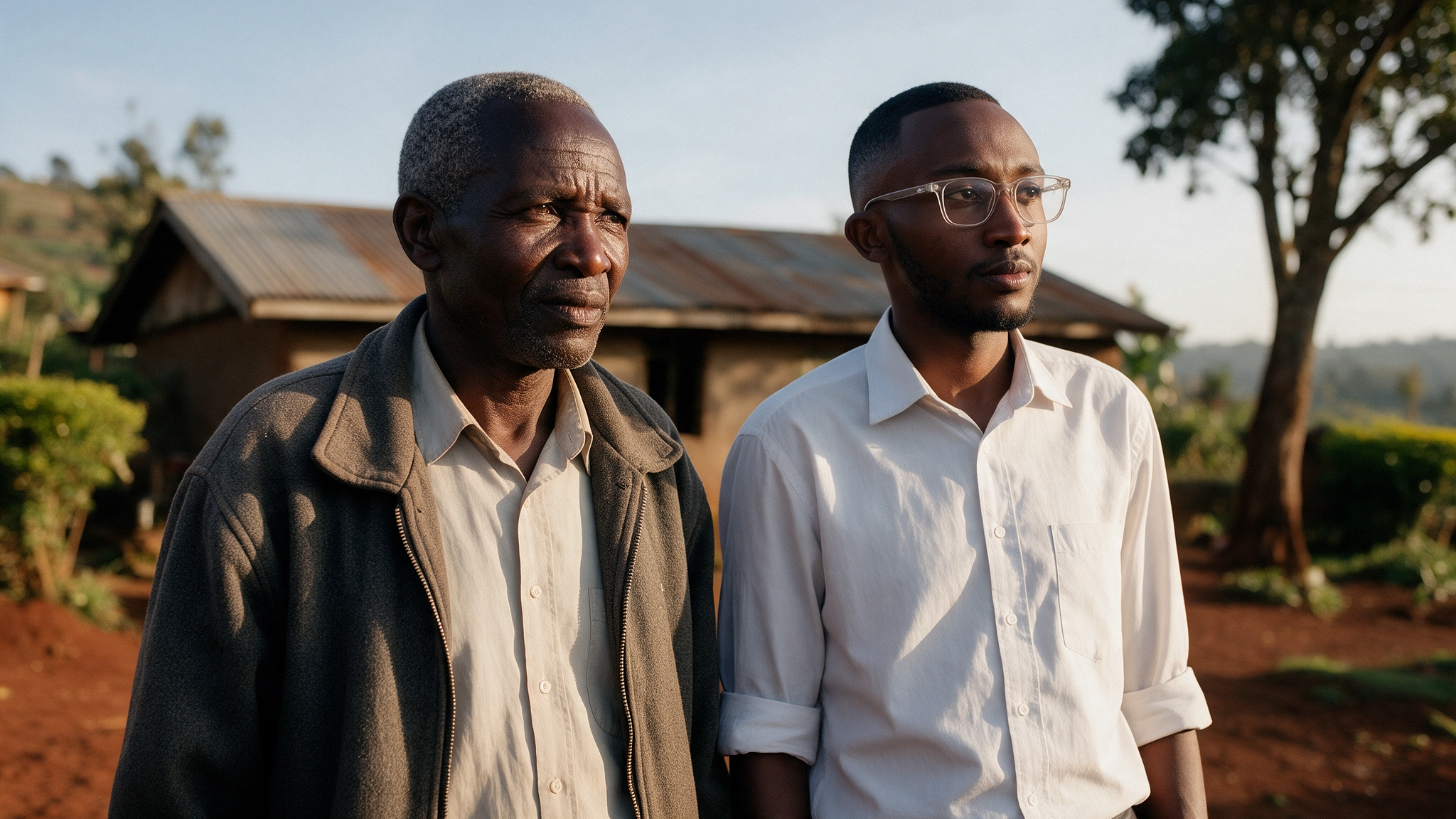
The apple does not fall far from the tree. Forgive me, I am from Nyeri, but I think I got that one right.
Here is what I mean. Most of who you are was borrowed. Your belief system, what you consider right and wrong, how you handle money, how you argue, how you show affection. Almost all of it came from your parents, and breaking generational patterns is difficult precisely because you inherited them before you were old enough to examine them.
Most of who you are was borrowed
I can tell you honestly that you can see my parents in me.
Not in the obvious ways people mean when they say a child looks like his father. I mean in the reflexes. What I consider rude. What I consider a waste of money. How I react when somebody is late. None of that was chosen. It was absorbed over 18 years of watching 2 people live, before I had any capacity to evaluate whether their way was the right way.
That is how it works for everybody. You did not sit down at 12 and select your values from a menu. You watched, and you copied, and by the time you were old enough to think about it, the copying was already done.
Men echo their fathers
For men especially, we echo our fathers.
If we saw our fathers as heroes, we repeat what they did, often without noticing. The way he spoke to our mother. How he handled pressure. Whether he came home. Whether he explained himself or simply issued instructions.
So a boy raised watching a drunk father often concludes that this is simply what life looks like. Not because he approves of it, but because it is the only model he was given, and a child has no comparison set. Normal is whatever happens in your house.
Some men veer away from it. But it takes deliberate work, and that is the part people underestimate. Drifting is automatic. Changing direction is not.
Parenting is the single biggest indicator of how a person turns out
One of the biggest indicators of how a person turns out is their parenting.
Not their school. Not their tribe. Not how much money the family had. The parenting.
Look at people carrying heavy trauma today. It rarely started somewhere else. It started at home, usually early, usually in ways nobody around at the time considered remarkable. That is why they say if you want to destroy a nation, destroy the family unit. Everything else in a society is downstream of what happens in people’s houses.
And it extends beyond the nuclear family. In our context, children grow up around cousins, uncles and aunts, and plenty of people were harmed by exactly those relatives. We must be honest about that rather than pretending the danger only ever came from outside the family.
If you are a parent, understand the weight of it
So if you are a parent, understand what you are actually holding.
The kind of father I become to my children will shape them for decades, long after I am no longer in the room to explain myself. A present father who guides consistently produces a very different adult from an absent one, and the difference is not marginal.
Consistency matters more than intensity here. Children do not need a perfect parent. They need a predictable one. A father who is warm on Monday and volatile on Thursday teaches a child that safety is temporary, and that lesson follows them into every relationship they will ever have.
The good news, if you want to call it that, is that this cuts both ways. If the pattern can be inherited, it can also be changed. The generation that stops it is the generation that decides to.

Now let me be careful here
Yes, people carry wounds from bad parenting. That explains a lot. It genuinely does.
But at some point, an adult must do the work of healing rather than repeating. Explanation is not permission. Understanding why you are the way you are is the first step, not the destination, and plenty of people stop at the explanation and stay there for 20 years.
Both things are true at once. You were shaped by things you did not choose, and you are still responsible for what you do with the result. Holding only the first half turns into permanent excuse. Holding only the second half is cruelty toward people who were genuinely harmed.
If that work is heavy, it is worth speaking to somebody qualified rather than carrying it alone. There is no prize for handling it by yourself.
Let us become better parents
Breaking generational patterns is not a single decision. It is a long sequence of small ones, usually made when you are tired and the old reflex is easier.
But somebody in every family line has to be the one who stops the thing. If you are reading this and you can already name what you do not want to pass on, that is the work, and it is yours.
Let us become better parents.
Start your digital skills journey on Click2Skill
— Elvis W.